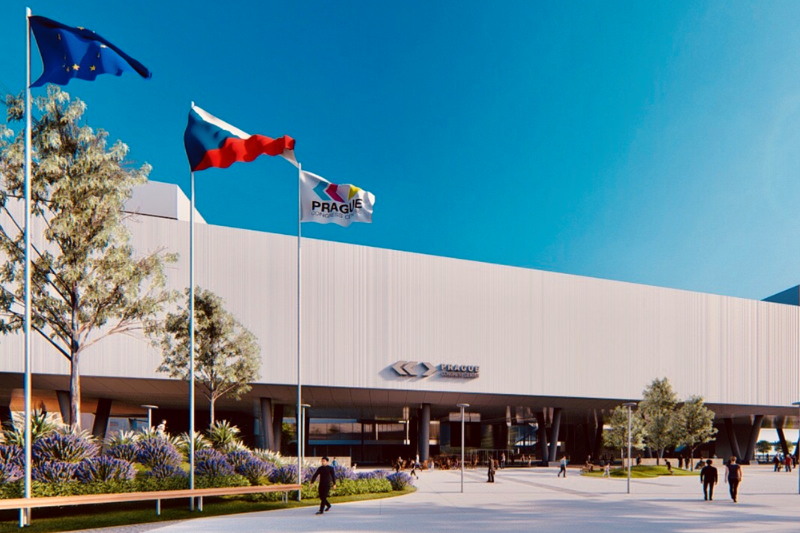
 Construction begins on the new Exhibition Hall. Modern architecture, state-of-the-art technology and maximum flexibility
The Board of Directors of Prague Congress Centre now consists of three members. Its Chair is the long-serving Chief Executive Officer, Ing. Lenka Žlebková, MBA, while Ing. Petr Dukát has been appointed Vice-Chairman of the Board and Deputy Director for Finance. The third member is Ing. Pavel Habarta, who is responsible for Technical Operations. In the interview, we spoke with all three about the company’s future direction and, above all, the construction of the new Exhibition Hall, which, after years of preparation, has finally moved fully into the construction phase – also thanks to the change in the company’s ownership structure.
The City of Prague is now the sole owner of Prague Congress Centre. How has this change benefited you?
Lenka Žlebková: Above all, this change has enabled us to unlock further investment in the development of Prague Congress Centre and, by extension, the city’s wider congress infrastructure. We had already been a partner of the City of Prague before this ownership change. However, we can now fulfil our role even more effectively – not only within the congress industry, but also as a strategic institution capable of assisting in crisis situations, as was the case, for example, with the Regional Assistance Centre for Ukrainian Refugees (KACPU) and the vaccination centre previously operated in our premises. Thanks to this change, the company can now implement long-prepared investment projects, including construction of the new Exhibition Hall and the revitalisation of the North Terrace. At the same time, the City of Prague gains not only an important social and cultural venue, but also the opportunity to fully realise Prague’s potential as one of the world’s five most attractive congress destinations.
After the slowdown caused by the Covid pandemic, Prague Congress Centre is thriving once again. How would you evaluate the past five years?
Lenka Žlebková: The past five years have been exceptionally successful for Prague Congress Centre. Not only have we seen significant revenue growth, but we also succeeded in restoring our strong international reputation. Thanks to the confidence placed in us by the Czech state, we secured the prestigious contract to host political meetings during the Czech Presidency of the Council of the European Union. At that time, approximately 2,400 leading political representatives from across Europe visited the Centre. Over the course of six months, we organised these events to the highest standard, including stringent security measures. These projects were significant for us not only in terms of prestige, but also because of their economic contribution. We closed 2022 with record profits, exceeding even the results achieved before the Covid-19 pandemic. The trust we gained, together with the security and IT infrastructure we developed, continues to generate further major international and political events. At the same time, we undertook a number of initiatives in the field of sustainability, and we are now one of the leaders in this segment in Central Europe.
How successful was 2025 in financial terms?
Petr Dukát: Once again, it was an extremely successful year for us. Our revenues exceeded the already very successful results of 2024, and we can confidently say that 2025 was a record year. Total revenues reached almost CZK 750 million. We also achieved an almost 50% increase in profit. However, this result was significantly influenced by the release of a provision for the new Exhibition Hall amounting to almost CZK 50 million.
What are your expectations regarding the construction of the new Exhibition Hall?
Lenka Žlebková: Construction of the new Exhibition Hall is crucial not only to enable the further development of Prague Congress Centre, but also for strengthening Prague’s position as a major global congress destination. It will allow us to host prestigious international events that we previously had to turn down due to limited capacity. We have a long track record of successfully attracting large and important congresses, but capacity limitations have restricted us in some cases. This is precisely why we decided to build the new hall and revitalise the surrounding area, including the North Terrace. The development will also include partial modernisation of the existing spaces, such as stage technology. This will enable us to open the venue to new types of events while offering modern, technologically advanced and sustainable facilities.
According to the ICCA international congress rankings, Prague is currently the fifth most sought-after congress destination in the world. Can we therefore assume that the new hall will strengthen Prague’s position even further?
Lenka Žlebková: Yes, the benefits for Prague and the Czech Republic as a whole will be significant. Large international events generate a strong multiplier effect that positively impacts not only the city budget, but also the national economy. In addition to their economic benefits, congresses and conferences also have wider professional and social significance – they strengthen Prague’s international prestige, foster partnerships and interdisciplinary cooperation, and support the development of science, research and innovation.
So what kind of facilities will the new multifunctional hall offer?
Pavel Habarta: The new hall will expand Prague Congress Centre by approximately 5,000 square metres of net exhibition space. It will be possible to divide this space into five sections, enabling exhibitions, conferences and gala evenings with round-table seating for up to 1,500 guests. We are already seeing demand from around fifteen of the world’s most important congresses, all of which are waiting for the new hall to be completed. At the same time, the hall will also host cultural and social events for the wider public. It also provides an opportunity to design the systems ensuring indoor environmental comfort in a coordinated and technologically integrated way – not only for the new hall, but for the existing buildings as well. This includes, for example, the cascade cooling system, which we plan to design to serve the current Prague Congress Centre building, including the requirements of all tenants, the Holiday Inn Prague hotel, part of the Business Centre Vyšehrad building and the new Exhibition Hall. The cascade system will consist of four units providing cooling in line with operational requirements. We will be able to cool all fully occupied areas simultaneously, even at the height of summer, while maintaining reserve capacity in the event of outages. At the same time, we aim to achieve further energy savings through the use of an additional modern unit connected to the cooling tower. Similar synergies can also be achieved in heating, water distribution, electricity supply and other systems.
How much will the construction of the hall cost, and who will fund it?
Petr Dukát: The construction of the hall is expected to require investment of approximately CZK 1.35 billion. This is one of the largest development projects in PCC’s 45-year history. I am proud to say that we will finance most of the project from our own resources – in other words, we are not simply holding out our hand to our shareholder, nor are we using a bank loan. It is true that our sole current shareholder, the City of Prague, has provided us with funding for development projects, including the new hall, which we greatly appreciate. However, these funds cover only around 20% of the new hall’s budget. The remainder comes from PCC’s business activities.
What are your expectations regarding the return on investment?
Petr Dukát: It's very difficult to determine the exact return on investment, as it consists of a number of factors – from the direct commercial benefit of the events held here to the multiplier effects associated with large numbers of visitors. The improvement of public space in this location is also significant. Nevertheless, the calculated payback period is 20 years, which is an excellent figure for a project of this kind with a wider public benefit.
Pavel Habarta: From an investment perspective, it should be emphasised that the construction of the hall itself certainly does not mean that other investments will stop, or that renewal and repair projects will be put on hold. Last year, investments totalled CZK 185 million, and this year – partly already in parallel with the construction of the hall – investment will reach a record CZK 205 million. What’s more, this does not include further investments by our clients – for example, the OMV filling station is due to be refurbished this summer.
What specific changes are planned around the building?
Pavel Habarta: We wanted our surroundings to serve not only our clients, but ordinary Prague residents as well. The North Terrace, with its view of Prague Castle, will feature a bistro, a viewing tower, water features and a much-needed lift connecting directly to the metro, making access easier for parents with pushchairs and people with disabilities – of whom there are many in this part of the city due to the proximity of the Jedlička Institute and Vyšehrad. The aim is to create new facilities for visitors and Prague residents, who can look forward to better barrier-free access to Vyšehrad metro station, as well as a new viewing tower with views of the historic city centre. On the south side, extensive surface works will be carried out. These will improve logistics within the site and, above all, access to the new hall, including a completely new and robust signage system, as well as new greenery, space for community gatherings and outdoor seating, a café at the entrance to the new hall, increased electric vehicle charging capacity and more. Personally, I’m looking forward to the shaded area beneath the new hall, where people will be able to sit and enjoy a coffee.
How were environmental considerations and sustainability taken into account in the project?
Pavel Habarta: The project has been designed to meet the LEED Gold sustainable building certification standard. For example, the new building will feature a retention tank for rainwater use and will help expand green areas around Pankrácké náměstí. Low-carbon buildings and LEED Gold certification are now almost synonymous with smart, energy-efficient and healthy indoor and outdoor environments. That’s what we wanted from the start. The measures include a sophisticated combination of initiatives, such as selecting suitable and abundant vegetation to reduce the urban heat island effect and restore local biodiversity, using permeable surfaces, supporting alternative zero-emission transport, rainwater management, using materials with a low carbon footprint, emphasising indoor environmental quality, and preserving daylight and views, among others.
Will the new hall make use of the technology in the existing building?
Pavel Habarta: In general, the existing building systems have sufficient capacity to serve the new hall as well. This includes, for example, heating and cooling supply. As regards cooling, we are consolidating requirements not only for the new hall, but also for part of the Business Centre Vyšehrad building, where we aim to further increase energy savings through a partial transition to mechanical cooling, as well as for the technical facilities of the former T-Mobile data centre. The redesigned cascade cooling system mentioned earlier will therefore be implemented. The air-handling, parking, IT, AV, security and fire safety systems will also need to be integrated. We intend to continue monitoring everything from the existing control centre and to maintain the standby operation of the company fire brigade.
Marketing KCP
2026-06-19